

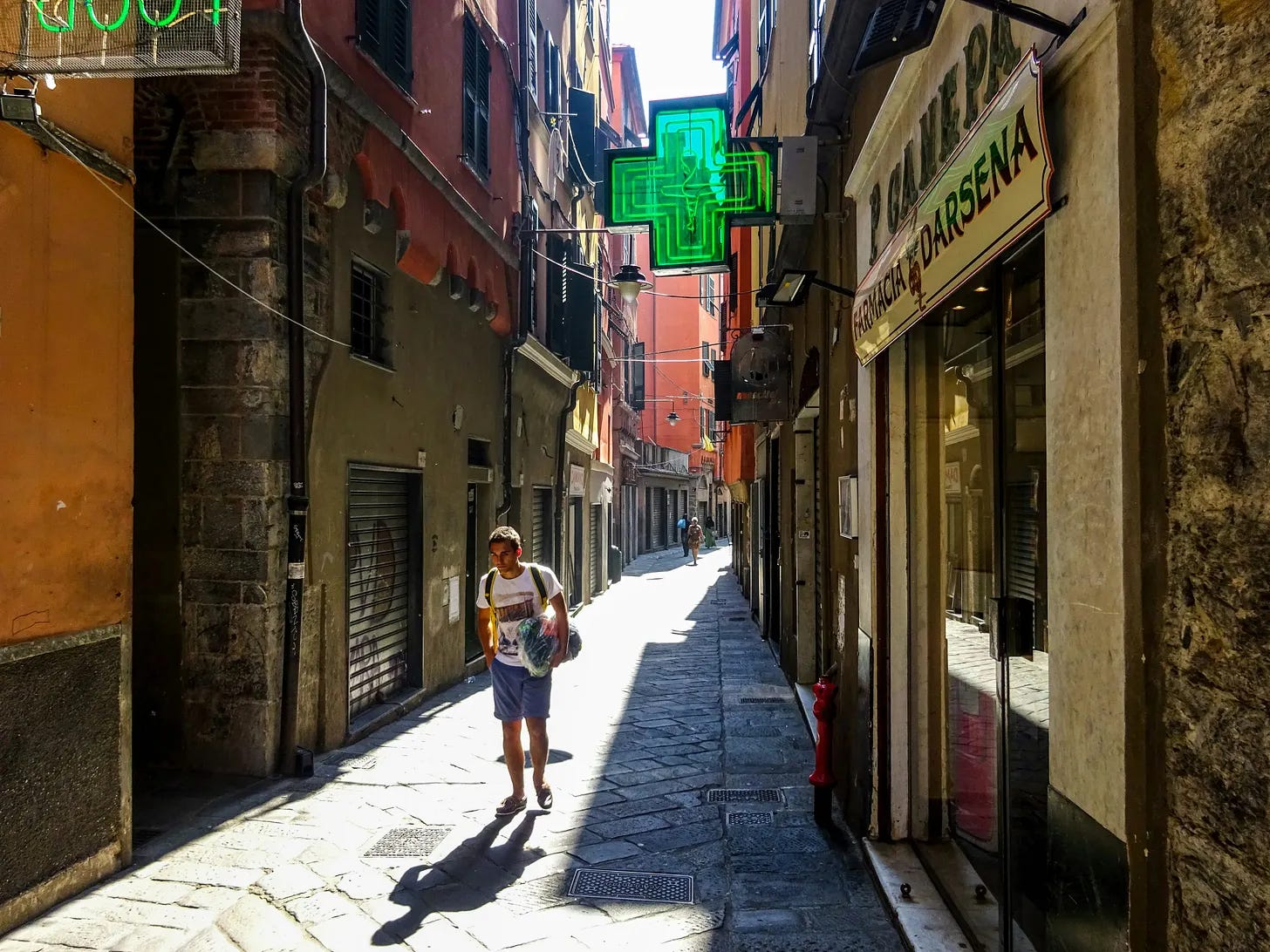
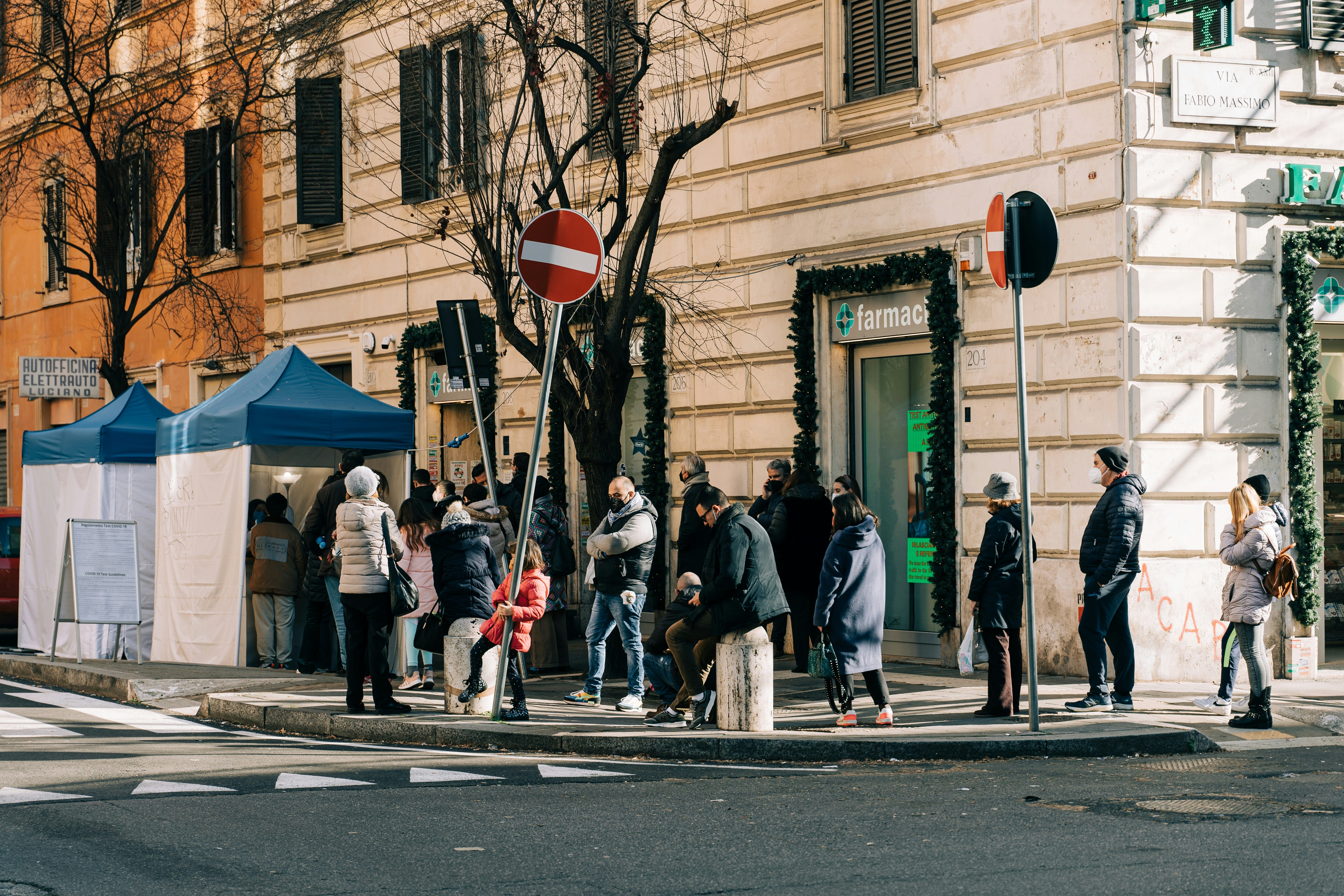
A few years ago, while living in Milan, there was always one thing I could count on on my walk home from the office: a queue around the block at each of the five pharmacies I would pass on my brief jaunt home. The lines were a fair representation of the Italian state’s demographics: many elderly people closer to eighty than seventy and a few parents with one child each. Some people smoked; others wore anti-smog masks; many stared at their phones, but everyone waited patiently as the line edged forward. Nobody looked particularly sick or agitated. On occasion, a loud sneeze would be met by literal jumps and polite nods of salute.
In towns the world, over there is usually a token establishment that acts as the social glue for its residents. In the British Isles this will often be the pub; in France the local brasserie or bakery; in India the chai shop; in rural America the Wal-Mart (or Facebook). But what about in Italy? The pizzeria or the coffee shop? The gelateria or the local football stadium? Try the local farmacia comunale.
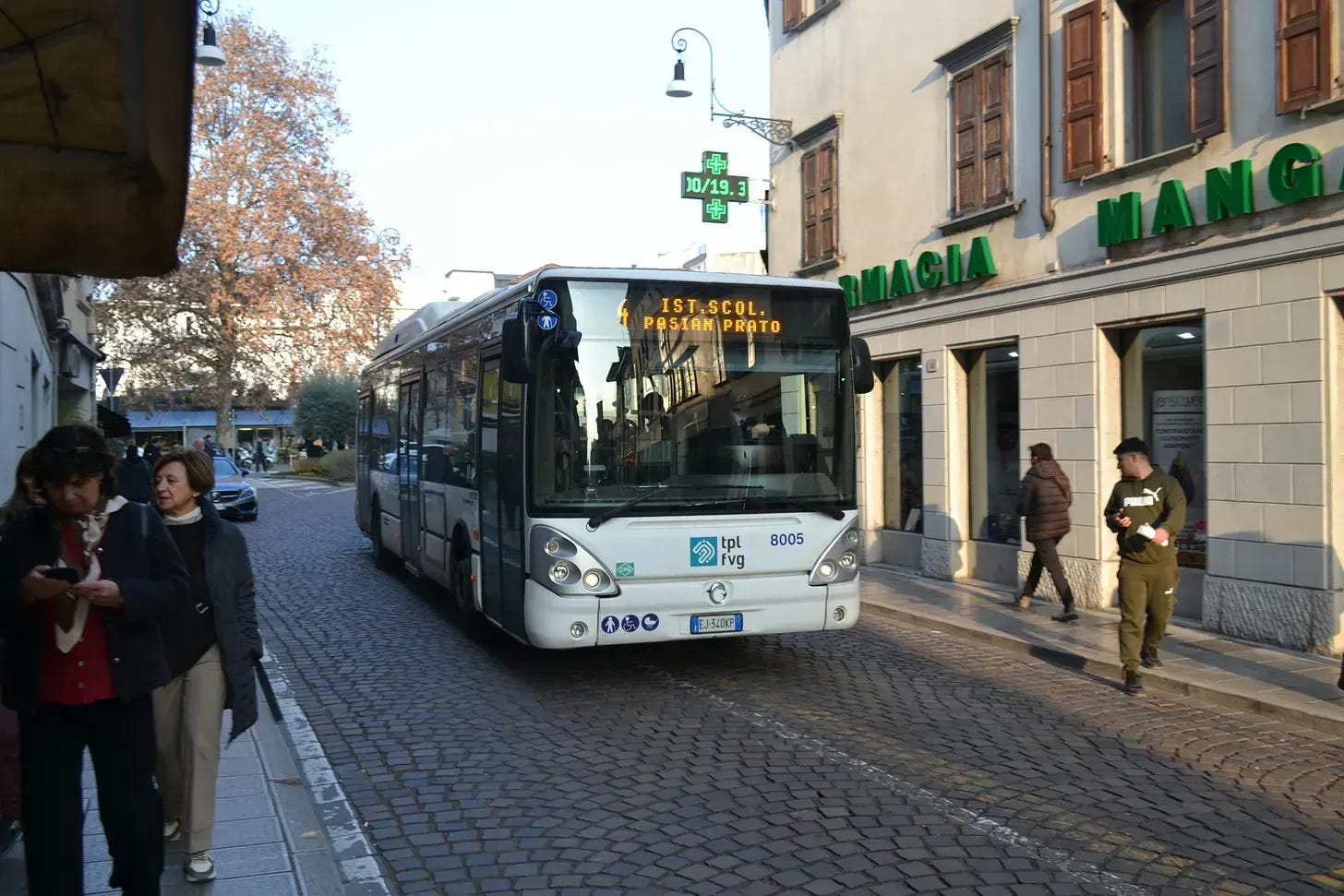
In Italy, pharmacies are king. As I came to discover, there is a constant revolving door of foot traffic under the blinking green cross no matter the time of day. Smallish towns of under 10,000 inhabitants often have three such establishments within striking distance of the central square. Most customers are habitual, of which a significant cohort are daily. You can tell who they are by the fact that they rarely buy anything more than a fresh box of aspirina and address the pharmacist like an old acquaintance. For an entire generation of Italians and their offspring, the farmacia has become a meeting point.
On a recent visit to the Tuscan countryside, I was frustratedly waiting in a pharmacy line with a snot-infested nose when a lady dressed in her Sunday best opened the door, came in and yelled across the shop to the chief pharmacist, “I will leave this door open for you to get the air circulating better.” She then left abruptly, not having bought anything or even attempted to. Rather, she needed an excuse to pop by the pharmacy and show the local tourists that she was someone to be reckoned with. After all, one does not simply just get to informally dare del tu1 to a powerful figure the likes of an Italian pharmacist. The elderly lady in front of us — still wearing a double FFP-2 facemask five years on from a pandemic — seemed to agree. After much talk to the pharmacist about the adventures of her grandkids off in a faraway land, she left with her daily dose of aspirina.
While waiting for the next customers to be diagnosed by the pharmacist, I noticed the vast array of health gadgets lining the checkout. A few, in particular, caught my eye: a mask hooked up to a steam machine, typically used to alleviate early cold symptoms for little kids; an extra large blood thinness measurer; special home covid tests, which claimed a higher accuracy than others. Next to all of those innovations were endless amounts of dermatologically recommended sunscreens. Many of these were fifteen SPF rather than the recommended fifty. After all, health precautions can only go so far; they may not interfere with an Italian’s maintenance of a year-round tan.
Fifteen minutes and twelve tissues later, it was finally my turn. The pharmacist — sporting typically Italian understated designer garments under her white lab coat — took her time scrutinizing my agony. She adjusted her glasses with an air of authority and analyzed every item I had picked out before scanning them at the checkout. She asked precisely what I was feeling in my throat to make sure that the spray I chose was, in fact, going to prove the most effective.
A few days later, with my sore throat and runny nose turned into full-fledged flu, I found myself queuing again, this time for something a bit heavier. It was only then that it finally hit me why the farmacia is such a hot spot. For starters, although they may not provide your daily espresso (yet), they have a near monopoly on over-the-counter medicine. If you need anything more than shampoo or deodorant, this is where you must come. It should thus be no surprise that the farmacia has become many Italians’ first port of call with any ailment.
Furthermore, the pharmacists on duty are, more often than not, highly-trained and skilled individuals who, due to the constant influx of clients and an aging population, have seen almost everything. As a result, they can act as shadow general practitioners within a relatively inefficient public healthcare system. They don’t shy away from the heft this provides, either. When Maria was pregnant with Leo three years ago and feeling a bit under the weather, I found myself at the farmacia being reprimanded and shamed for requesting a medicine that our doctor back in Denmark had approved, but that no Italian pharmacist with their decades of first-hand training would allow a pregnant woman to ingest. (I had to cross over to the rival pharmacy across the street under disguise and lie that the medicine was for me in order to finally get it.)
Of course, none of this would matter if Italians were more hands-off in their approach to minor ailments, but they are a country of God-fearing hypochondriacs. There are diseases in Italy that do not exist anywhere else. Take, for example, the obsession with il colpo d’aria (literally: the hit of air). Any slightly cold air can be enough. Air conditioning below twenty-three degrees Celsius can lead to a colpo d’aria. So can going outside with wet hair — even in summer. As a result, an entire industry of silky, fashionable and relatively expensive scarves has blossomed. People will wear them on the beach in thirty-five degree heat, so long as their farmacista di fiducia2 has consented to their trip.
Then there is Italians’ obsession with their digestive process and GI issues. Any slightly upset stomach will lead straight to the village pharmacist where they will tell you off for having had a cappuccino after eleven3. Children are not allowed to swim in the water for three hours after lunch. A cynic would say this is so their elders can nap, but a pharmacist who does the grandma’s bidding after years of loyal patronage will probably find a way to back up the assertion scientifically.
The one everyone fears however, is the cervicale. The dreaded cervicale can come for you when you least expect it. It is a mystery but seems to be an all-encompassing disease that ensures dashes to the pharmacy. Oftentimes, when you can’t be diagnosed with anything else, it is cervicale. That feeling of a sore neck after sleeping on a new pillow? Cervicale. Sore back? Cervicale. Feeling down? Cervicale. The cervicale category encapsulates any pain located somewhere between your middle spine and your cranium.
Nobody knows exactly what it is or can do, but everyone fears it. Saying “ho la cervicale” is a valid excuse for getting yourself out of anything from dinner with your in-laws to a speeding fine. What is unclear is whether people fear it because of the purportedly wide-ranging symptoms or because it is the one thing their beloved pharmacist has not yet found a cure for other than swaddling you in a fancy scarf.
How to claim back your travel experience with GlobeFoxing
At GlobeFoxing, we are all about travel done differently. We don’t just write about the world of travel, we make it happen. If you would like GlobeFoxing to craft a trip catered specifically to your needs, and avoid the classic pitfalls of traveling abroad, then just get in touch here!

Informal greeting in Italy as opposed to the lei normally used out of respect for strangers, authorities and the elderly.
A farmacista di fiducia is your trusted pharmacist. In Italy, whenever the expression di fiducia is added to a profession (doctor di fiducia, driver di fiducia, hotelier di fiducia etc etc), it carries immense weight. The greatest stamp of approval in Italy is someone you have deemed trusted and sharing them with anybody else is usually done in hushed and reverential tone. The only thing that beats your trusted (insert profession) is calling them the best (insert profession) of their generation. Which begs the question: what would make a pharmacist (or mail delivery person or teacher or police officer) the best of their generation?
Order a cappuccino in an Italian cafe after the morning rush and you’ll be guaranteed some nasty looks from patrons. This is ostensibly because milk in coffee is considered something exclusively for breakfast. When you dig deeper and provoke whoever is telling you this at risk of getting your head steamed and frothed, you will be told that milk hinders your digestion. The logic goes that having it later in the day could interfere with your digestive process and result in sleeping issues. So, it could very well be that after so many generations of abstention from milky afternoons, Italians have evolved to be lactose intolerant from 11:00 AM until 6:00 AM the next day.
Great post Nico! But I laugh, because in California, when medical weed was first legalized, there was a dispensary called The Green Cross. I used to get all excited to see the green cross signage in other countries, only to learn they were actually just ordinary pharmacies. 💚
A good smile in the morning! There is a German book, written in the Fifties, called "Eine Reise nach Neapel... e parlare italiano". It's any easy way to learn Italian by reading that book. It says "If you are looking for the best restaurant in an Italian town, go to the pharmacy. Italian pharmacists eat very well and know where to find the right spot."